
Product
May 27, 2026 · 6 min read
The Difference Between Retail Reporting and Retail Intelligence
Most retail CRM platforms aren't telling you what to do. They're telling you what already happened.
Walk into any specialty retailer doing a few million in revenue and ask the owner how their email marketing is performing. They'll quote you the open rate. Ask about same-store sales, they'll quote you the year-over-year. Ask about loyalty, they'll quote you the member count.
Now ask which of their customers are about to lapse. Or which loyalty tier is silently underperforming. Or where first-visit churn is bleeding margin across their locations. The room gets quiet.
This is the gap between retail reporting and retail intelligence. Most retail CRM platforms are very good at the first one. Almost none of them deliver the second.
The difference between reporting and intelligence
Reporting tells you what happened. Intelligence tells you what to do about it.
Your POS shows you what sold last week. That's reporting. Your loyalty platform shows you how many people signed up this month. That's reporting. Your email tool shows you opens and clicks. That's reporting.
None of that tells you that 18% of your best customers haven't been back in 90 days and are about to roll into the lapsed segment. None of it tells you that your Silver tier is leaking to Bronze instead of climbing to Gold, which means your loyalty program isn't doing the job you built it for. None of it tells you that one of your four locations has a first-visit return rate half the others, and you're spending acquisition dollars to fill a leaky bucket.
That's intelligence. And the absence of it is why most small and mid-sized retailers are running on gut feel and platform defaults, even when they have real data sitting underneath.
Why this gap exists
It's not because the data is missing. Most multi-location retailers have plenty of data. The POS has every transaction. The loyalty platform has every signup, every tier, every redemption. The email tool has every send and every click. The data exists.
The gap exists because reading that data well takes three things most operators don't have at the same time: the analytical chops to know what to look at, the time to actually do it consistently, and a CRM strategy that turns the answers into specific campaigns.
A POS vendor isn't going to give you that. Their job is to sell you a POS. They include a "reports" tab because they have to, not because they expect you to extract strategy from it. The same is true of every loyalty platform and email tool. The dashboards are built to keep you logged in, not to tell you what to do next.
So the work falls on the operator. And in our experience working with small and mid-sized retailers, that work doesn't get done. Not because owners don't care, but because they're running the business. Reading data well at this depth is a full-time analytical role, and most SMBs can't justify hiring one.
What retail intelligence actually looks like
Let's get specific, because "intelligence" is the kind of word that means nothing unless you tie it to actual outputs.
A real retail CRM intelligence layer should tell you, at minimum, the following things, every month, without you having to ask:
Where your customer base is healthy and where it's leaking. First-visit churn rate by store. Repeat rate by location. Tier migration patterns. Dormant customer counts. These are the diagnostic vitals.
Which customers are about to lapse and which are about to grow. RFM segmentation, recency-frequency-monetary scoring, tells you exactly which segment each customer sits in right now. You should know who your VIPs are, who's at risk, who's lapsed, and who's quietly building toward loyalty without anyone noticing.
Where the revenue actually comes from. Not just total revenue. Revenue by tier, by store, by category, by segment, by recency band. Most retailers discover that 20% of their customers drive 55% of revenue once they look at it cleanly. That changes how you spend marketing dollars.
A specific plan for the next 90 days. This is the part most reporting tools never get to. Given what the data shows, what should you actually do? Which segments deserve campaigns? Which retention plays will pay back hardest? What's the sequencing? A real intelligence layer doesn't stop at "here's what's happening." It tells you "here's what to do about it, prioritized by impact."
If your current CRM stack isn't delivering all four of those, you don't have a retail CRM intelligence layer. You have a reporting tab.
Why this matters more for multi-location retailers
If you operate a single store, you can keep most of this in your head. You see the regulars. You know the weekly rhythm. You can feel when something's off.
The moment you add a second location, your intuition stops scaling. Now you have two customer bases, two transaction patterns, two repeat-rate trends, two leaky buckets. Add a third or fourth location and the comparative work, which store is doing what well, where the playbook from one should apply to another, becomes impossible to track by feel.
Multi-location is where the intelligence gap costs the most. Because the operators who handle it best aren't the ones with better instincts. They're the ones who built or bought a system that surfaces the cross-store comparisons automatically, every month, in a format that says "here's what's different, here's why it matters, here's what to do."
Without that, every multi-location retailer eventually treats their stores as one undifferentiated whole, which means the location-specific opportunities and problems stay invisible.
Building intelligence on top of what you already have
The standard pitch from CRM vendors is "rip out what you have and use ours." Most retailers can't and shouldn't. Your POS works. Your loyalty platform works. Your email tool works. Replacing them is a six-figure mistake.
The right approach is to build an intelligence layer that sits on top of what you already use. Your POS handles transactions. Your loyalty platform handles members. Your email tool handles sends. The intelligence layer reads all three, unifies the data, and produces the diagnostic and prescriptive output none of those tools were built to deliver.
That layer doesn't replace anything. It connects to the tools you already have and turns the data those tools are already collecting into something you can act on.
What we built
We've been doing CRM and lifecycle marketing work for over a decade across hospitality, gaming, and specialty retail. The same pattern showed up in every category: rich data, thin intelligence, operators making decisions on gut feel because nobody had built the layer that would let them do otherwise.
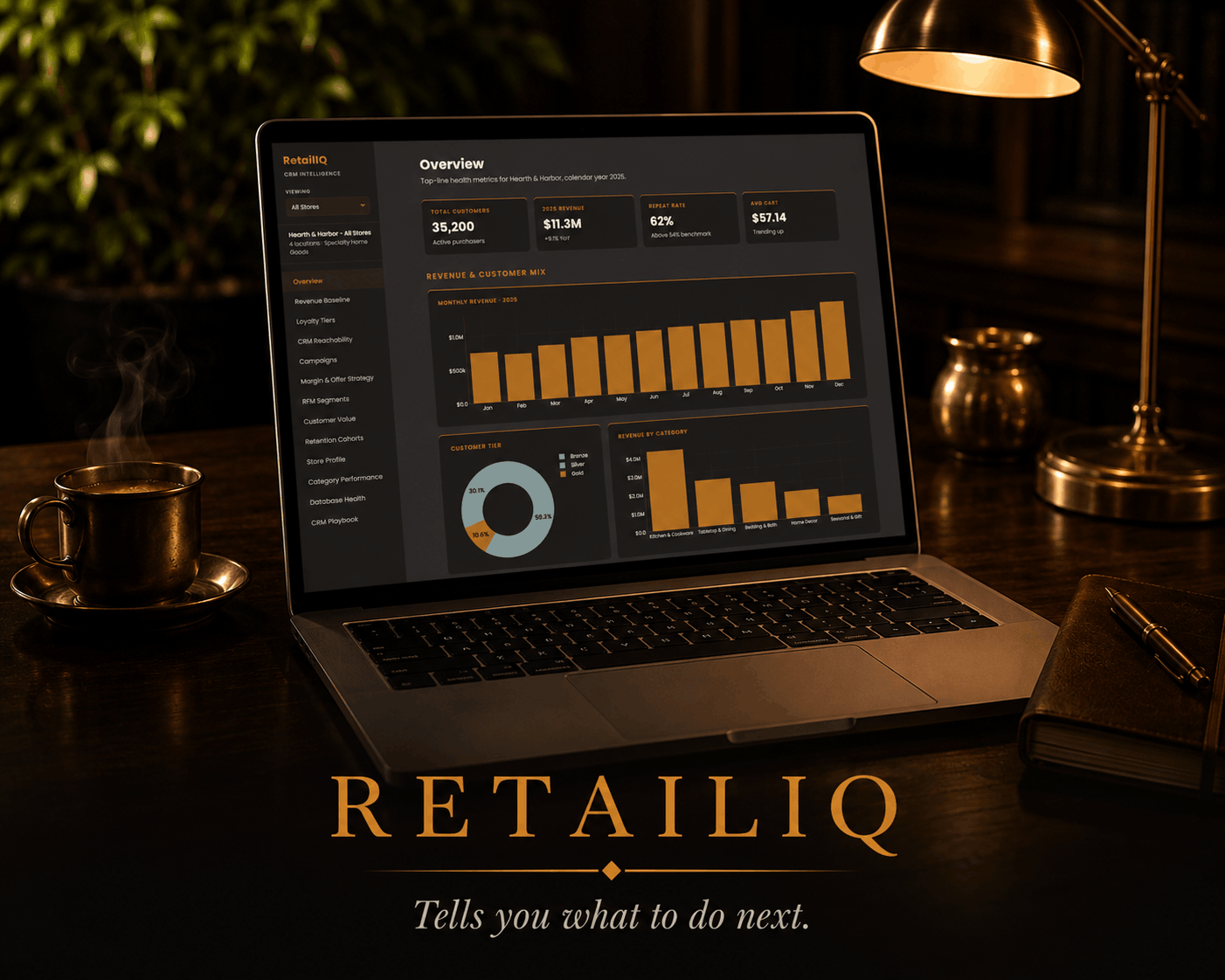
So we built it. RetailIQ is a CRM intelligence dashboard for small and mid-sized retailers, designed specifically for independent and multi-location specialty operators. It connects to your POS, your loyalty platform, and your CRM, and produces thirteen analytical views plus a prescriptive CRM playbook tied to your data.
The thirteen views cover every diagnostic and behavioral angle that matters: RFM segments, loyalty tier migration, retention cohorts, customer value distribution, category and store-level performance, database health, channel reachability, campaign performance, and more. The playbook turns the data into specific plays, the segments to target, the campaigns to run, the sequencing to use, with estimated revenue impact for each.
It's built for the operator who knows their data is telling a story and wants someone to read it for them. Not enterprise software. Not a generic SaaS dashboard. A managed intelligence layer scoped to the specialty retail business you actually run.
If you operate a single store or a small chain and you've been making CRM decisions on gut feel, that's not a knock on you. It's an artifact of the gap between what your current tools deliver and what real intelligence looks like. The work is to close that gap.
You can see what the dashboard looks like, built on synthetic data for a four-location specialty home goods retailer, at our live demo. If the structure looks like the thing you've been missing, we should talk about what your own version would look like.